The Temporary Church, 1851–1872
All was not plain sailing for the church in the new settlement. Between 1851 and 1872 there was persistent conflict over buildings, finance, and leadership as the Anglican church in Christchurch evolved from makeshift beginnings into a more structured parish system.
The rudimentary V-hut on church reserve land, the first place of worship set up in 1851 was followed later that year by a small wooden “schoolroom-church.” This dual-purpose building, known as the Temporary Church, or The Church at Christchurch, served as both church and school until a separate schoolroom was built, freeing the church for worship. The Rev. George T.B. Kingdon (1851–1852) the first chaplain, ministered in extremely primitive conditions. His tenure was brief, marked by hardship that led to the loss of what was to be their only child and dissatisfaction with unmet expectations as the Canterbury Association struggled financially. The eventual failure of the Canterbury Association meant that despite the growing population and the inadequacies of the building (in some parts of the building the service could not be heard, and the very tall would hit their heads on low beams) there was simply no money to replace it with a permanent structure. The best that could be done was to extend the building.
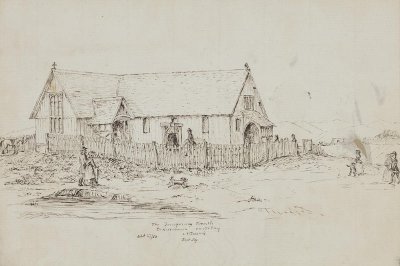
The Temporary Church 1854 Dr A.C. Barker Acc.1949.29.2 (Canterbury Museum, no known copyright restrictions)
A parsonage was also begun early but delayed, reflecting those wider financial difficulties. The Rev. Octavius Mathias (1852–1860) served as the first long-term incumbent. Though energetic in civic and agricultural life, he saw himself more as a squire/parson and to the frustration of many, neglected pastoral duties and church development. His leadership was often contentious, especially in disputes over church property and governance. Under him, church building stagnated, and parish organisation remained weak. He largely left the running of the parish to his assistant curates.
By the late 1850s, pressure for a proper church had increased. Instead of replacement, further extensions allowing for another 100 seats were made, and in 1859 the building was finally consecrated. The consecration was at the commencement of a service to mark the opening of the Provincial Council on 29 September 1859, the feast of St Michael and All Angels, and thus the Church and Parish were named.
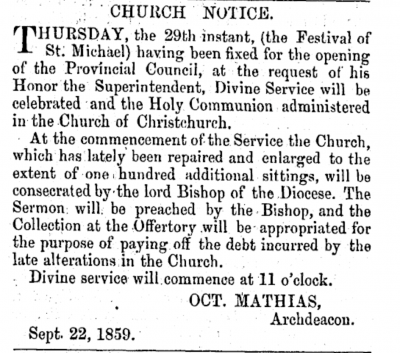
Lyttleton Times, 24-09-1859 (Papers Past)
In the growing town other buildings gradually supplemented St Michael’s. St Luke’s (opened 1860) functioned as a chapel of ease, while a belfry at St Michael’s (1861) improved the audibility and civic role of the church bell. Despite these additions, Anglican buildings were often considered inferior to Presbyterian and Methodist churches. While the growing population was increasingly secular or non-Anglican the settlement’s Anglican beginnings meant there were proportionally more Anglicans putting pressure on the resources of the Anglican church. In the 1860s, debate intensified over whether to extend St Michael’s, build new district churches, or prioritise a cathedral. Temporary solutions prevailed: further additions to St Michael’s and St Luke’s, and the use of public halls for services. A new stone church, St John’s in Latimer Square (consecrated 1865), provided some relief.
Parish Changes
Initially Christchurch did not exist as a separate Diocese, but formed part of the Bishopric of New Zealand overseen by Bishop Selwyn whose responsibilities included all of Aotearoa New Zealand and Melanesia. In 1856 constitutional changes enabled the subdivision of the Diocese of New Zealand to establish the Diocese of Christchurch. Prior to this Christchurch functioned as a vast, loosely defined parish covering most of the Canterbury settlement. Early attempts at organisation (1851–1854) created only broad districts without effective local structure, largely due to the absence of a bishop and formal authority.
The appointment and arrival of Bishop Harper in 1856 brought clearer direction.
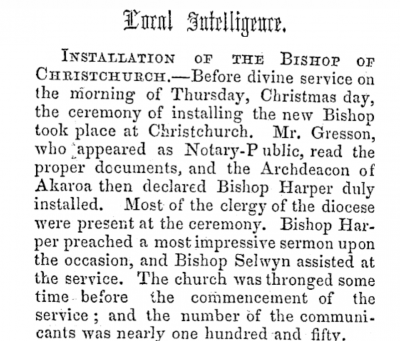
Lyttleton Times, 27-12-1856 (Papers Past)
He was installed on Christmas Day 1856 in the chair (stylistically attributed to Benjamin Mountfort that can be seen to this day in St Michael’s. From 1856 until the opening of Christ Church Cathedral in 1881 St Michael’s was to be the Pro-Cathedral of the Diocese.
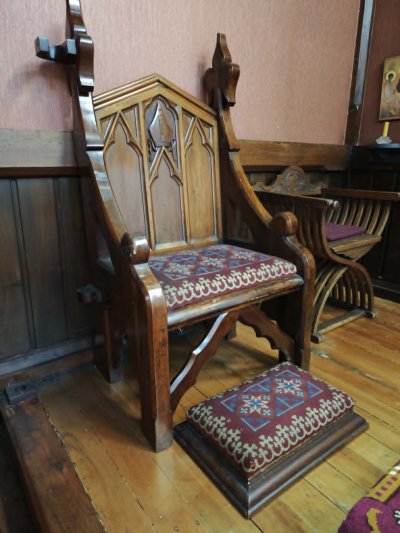
Bishop's Chair (John Nicholson)
A diocesan constitution (1857) and synodical governance (from 1859) enabled more formal parish recognition and lay participation. Christchurch parish was officially recognised in 1859 after the consecration of St Michael’s.
Mathias resigned in 1860 and a prolonged vacancy (1860–1863) followed. Bishop Harper acted nominally as incumbent, assisted by clergy such as Charles Alabaster, whose promising ministry was cut short by ill health and Henry B. Cocks (1862–1863) who briefly served as incumbent and was well regarded, but whose tenure lasted little more than a year.
The Rev. Henry Jacobs (1863–1873) finally provided the first stable and effective leadership (obituary. A scholar and educator, Jacobs brought continuity and pastoral commitment. During his decade, the parish began to stabilise, parish structures improved, and gradual progress was made in addressing accommodation and organisational challenges. He also oversaw the parish during significant urban growth and social change. In 1866 he was appointed dean of Christchurch, retaining the charge of St Michael’s until 1873. The Cathedral build was stalled due to financial constraints, and it was Jacobs who oversaw the opening of the nave of a new, more substantial church building for St Michael’s, marking a transition out of the “makeshift” era.
However, the parish remained too large for effective ministry. Throughout the 1860s, there were repeated but hesitant moves toward subdivision. Financial difficulties and uncertainty over clergy support slowed progress.
The first major division came in 1865 with the creation of the parish centred on St John’s (Latimer Square). Further pressure led to the separation of St Luke’s parish in 1866, leaving a reduced St Michael’s parish. These changes marked the transition from a single, unwieldy parish to a more typical urban pattern of multiple parishes, though the process was slow and contested.
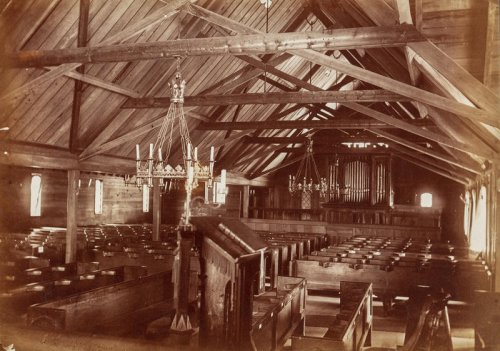
The Interior of the Church post 1866 (note pew numbers), ACC 2016.15.45 (Canterbury Museum, no known copyright restrictions)
Pew Rents (a 'Christchurch stoush')
These years were marked by financial difficulties. A proven solution was the introduction of Pew rents—charging parishioners for reserved seats—this had been widely used in England and by other denominations in Christchurch, leading some Anglicans to support them as a practical solution to ongoing financial difficulties. Proponents argued that without a dependable income stream, the parish could not adequately fund clergy or expand church buildings to meet the needs of a growing population.
Opposition, however, was strong and rooted in principle. Many early settlers, influenced by the ideals of the Canterbury Association, believed the church should remain “free and open” to all. They argued that pew rents would introduce social divisions into worship, privileging wealthier parishioners and undermining the spiritual equality of the congregation. Clergy, including Bishop Harper and Bishop Selwyn, largely opposed the practice, seeing it as inconsistent with the church’s pastoral mission.
While rejected in 1861, the issue again came to a head again in 1863, when a large parish meeting decisively rejected pew rents. Financial problems persisted. Voluntary giving proved unreliable, and parish debt increased, limiting the church’s ability to expand. In contrast, the newly formed parish of St John’s adopted pew rents with little resistance, indicating a shift in attitudes, particularly among newer settlers.
By the mid-1860s, the question resurfaced as financial pressures intensified. The debate highlighted a broader tension within the colonial church: whether to uphold founding ideals of inclusivity or adapt pragmatically to economic realities. In 1866 the vote for Pew Rents was finally carried with provisos: not all seats would be let, some could be allocated to poorer parishioners, all seats were to be free from the time the bell ceased ringing, and on all occasions when the Bishop was present (thus recognising the church’s position as the pro-cathedral). By 1867 St Michael’s was well on the way out of its financial difficulties.
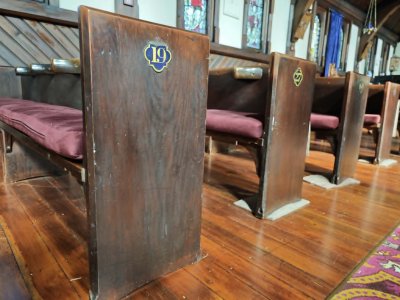
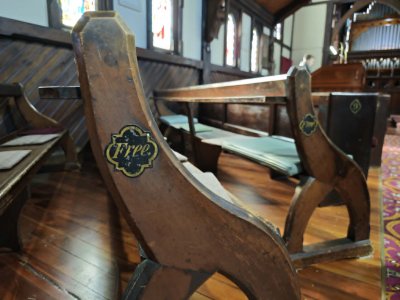
Numbered and free pews (John Nicholson)
The pews in St Michael’s still bear the pew rent numbers, and the Diocesan Archives hold some records of who sat in which pew.
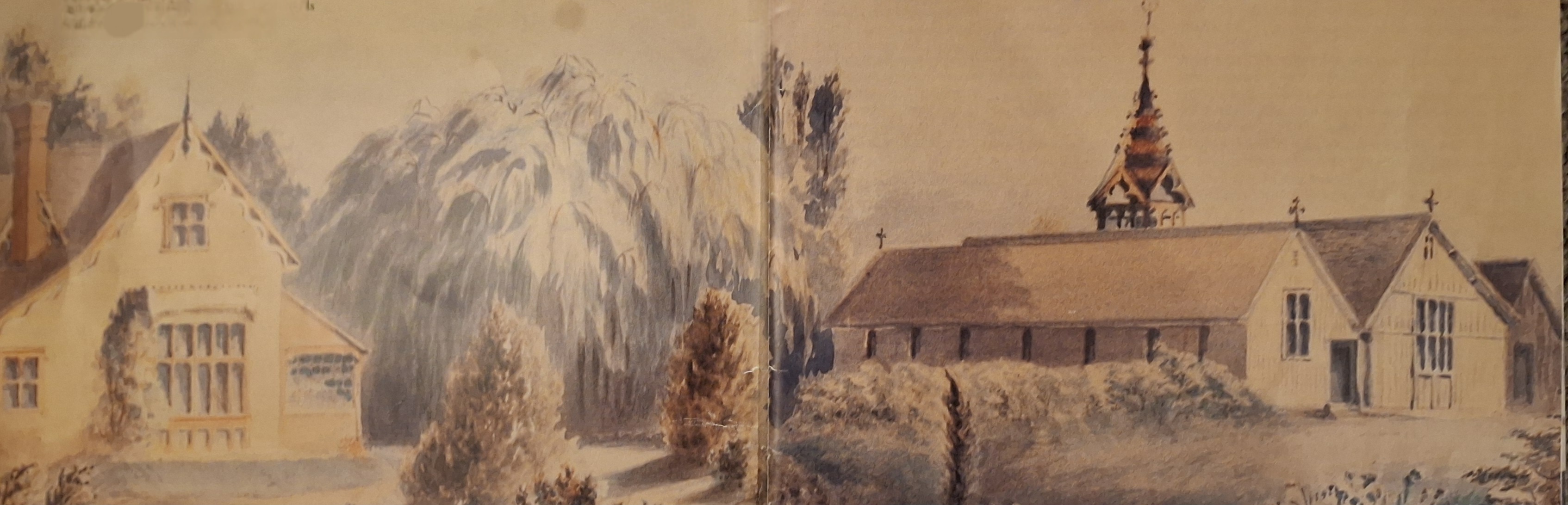
Unnamed watercolour of the Church and Parsonage (late 1860s) owned by the Parish and held by the McDougall Art Gallery.
From 1851 to 1873, the Christchurch parish moved from improvised buildings and undefined structures toward a more organised ecclesiastical system. Persistent financial struggles, disputes over priorities (especially cathedral versus parish churches), and uneven clerical leadership slowed progress. Yet by the early 1870s—with parish divisions established, stronger leadership under Jacobs, and the construction of a substantial new church building—the foundations of a stable Anglican presence in Christchurch had been firmly laid.
Johnann Williams
Sources
Peters, Marie. Christchurch-St Michael's: A Study in Anglicanism in New Zealand, 1851-1972
St. Michael and All Angels, Christchurch: Commemorating 150 Years: Church and School 1851-2001
https://anglicanhistory.org/nz/blain_directory/directory.pdf
https://my.christchurchcitylibraries.com/local-history/
https://collection.canterburymuseum.com/explore
https://paperspast.natlib.govt.nz
https://teara.govt.nz/en